
by Narain Jashanmal on December 11, 2025

ChatGPT has 800 million weekly users. It processes 2.5 billion messages a day. And yet, by the metric that actually matters, it's not a habit, it's a tool.
The tell is in what OpenAI doesn't report. They'll report monthly actives, weekly actives, messages processed. What they won't say is daily active users as a share of monthly: the "stickiness ratio" that separates habits from utilities. Industry estimates put ChatGPT's daily actives at around 120 million; against a monthly user base north of a billion, that's a stickiness ratio under 12%.
Compare that to the products people don't decide to use, but simply reach for: Meta's family of apps clocks 69%. Duolingo, an app that teaches you Spanish, hits 37%. These aren't just more popular. They're wired in differently.
The distinction matters because it challenges a comfortable assumption most product teams make: that habit-formation is relevant for some categories (social, entertainment, fitness) but not others. "No one books travel daily," the thinking goes. "No one files taxes every morning."
This mentality is a trap. The question isn't whether your users will engage daily, it's whether you've done everything possible to become the reflexive answer to the problem you solve. If you haven't, you're not competing against other travel apps. You're competing against the search bar, and increasingly, the chat window. Neither remembers you exist.
The difference between the products that get wired into someone's day and the ones that get Googled isn't luck. It's circuitry.
The Intentional Habit
Reaching millions is not the same as becoming a habit for them. Products conflate scale with stickiness all the time: hit the growth targets, watch engagement emerge, call it strategy. But the products that become rituals don't back into habits. They build for them.
The uncomfortable truth is that habit-formation is a discipline: a set of choices that compound over time. It's not a feature you ship or a growth hack you deploy. It's a structural commitment that touches product, engineering, and marketing simultaneously.
And most teams never make it. Not because they lack talent or resources, but because they've convinced themselves the goal doesn't apply to them. They're building for "high-value, low-frequency" use cases, a framing that sounds strategic but functions as surrender.
The products that achieve default status don't stumble into it. They're engineered to become part of the user's circuitry, wired in through a set of choices that, once you see them, show up in every product that's crossed from useful to reflexive.
The Physics of a Reflex
Two models underpin nearly every habit-forming product, whether the teams that built them would name them or not. The first explains how a single action happens. The second explains how that action becomes a loop.
The action: BJ Fogg's behavioral equation states that for any action to occur, motivation, ability, and a prompt must converge in the same moment. Miss any one and nothing happens.
The insight that matters here isn't the formula itself; it's the trade-off it reveals. Motivation and ability compensate for each other. A user with intense motivation will tolerate a clunky interface. But a product with near-zero friction can capture users with almost no motivation at all.
This is why the infinite scroll works: the action is so effortless it can be triggered by undifferentiated boredom. The product doesn't need you to want something. It just needs you to be holding your phone.
The loop: Nir Eyal's hooked model describes what happens after that first action—and how it becomes self-sustaining. Trigger, action, variable reward, investment. The trigger initiates. The action is performed in anticipation of reward. The reward, crucially, is unpredictable; this is what makes it compelling rather than merely useful. And the investment is whatever the user puts back into the product: time, data, preferences, social capital. That investment loads the next trigger, and the cycle repeats.
Each pass through the loop is a strand of wire wrapped around the user's day. Enough passes and the connection holds on its own.
The catch: What makes these models powerful together is a single, counterintuitive finding. You can plot a product's habit potential on two axes: how often someone uses it, and how valuable they find it. The "habit zone" sits in the upper right. But the curve that defines that zone never touches the utility axis.
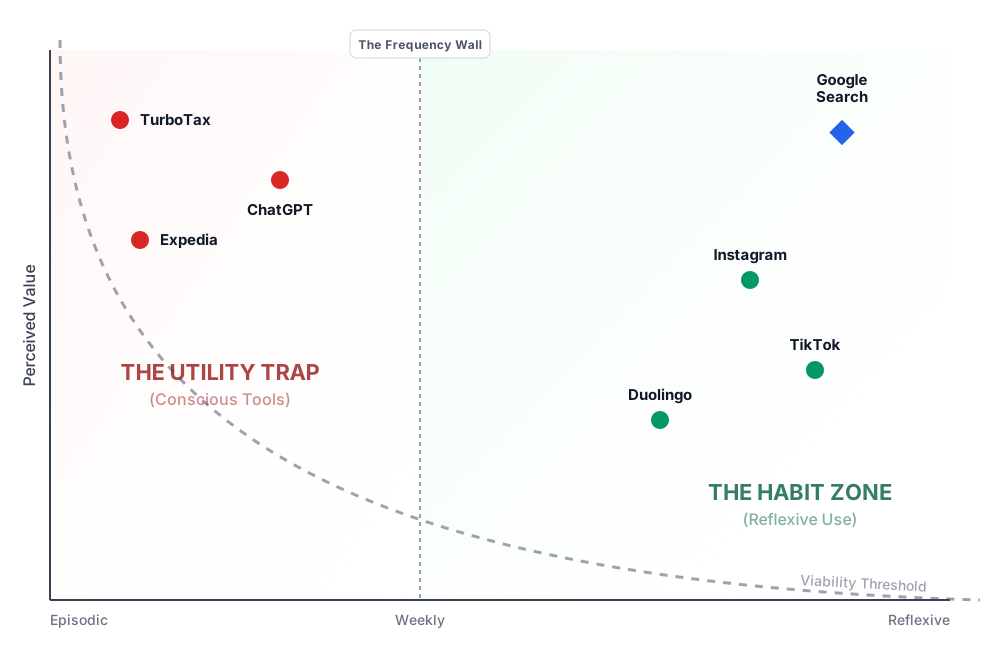
No amount of value, however high, creates a habit if the frequency is zero. The brain doesn't wire episodic value into reflex. It wires frequency.
This is the structural explanation for why high-utility tools struggle to become defaults: tax software, travel booking, even a brilliant AI assistant. They deliver enormous value, but they deliver it episodically. The wiring never takes hold.
The implication for product teams is uncomfortable: if you're only showing up when users have a specific need, you're training them to forget you between needs. The products that become reflexive are the ones that manufacture reasons to return daily, or close to it, until the external prompt becomes unnecessary and the internal trigger takes over.
The Anatomy of Defaults
The products that have crossed into habit territory share structural DNA, even when their surfaces look nothing alike.
TikTok is the purest example. Most apps ask you to do something before they reward you: search, scroll, choose. TikTok skips the ask. Open the app and a video is already playing; the reward loop is running before you've made a single decision. The core action, a vertical swipe, requires so little effort that it barely qualifies as a choice. And every interaction, from a completed watch to a mid-video swipe, feeds a reinforcement learning loop optimizing for one thing: more of your time. The model updates with each session; the product learns you faster than you learn it.
The investment isn't content you create or connections you build; it's attention itself, metabolized into personalization. Each session solders the connection tighter. The product gets better at capturing you the more you let it.
Duolingo operates on different terrain but follows the same logic. The surface motivation is aspiration: learn Spanish, pick up French, finally tackle Japanese. But the circuitry quietly shifts what you're actually protecting. After thirty consecutive days, the streak counter becomes the point. Users who started with "I want to learn a language" find themselves driven by "I can't lose my streak."
The app has manufactured a new internal trigger: loss aversion, that fires more reliably than the original aspiration ever did. The owl notification isn't reminding you to learn; it's reminding you what you stand to lose. The wire isn't connected to your goals anymore. It's connected to your fear.
Spotify's Discover Weekly solves a different problem: how do you build a habit around content that isn't inherently daily? Their answer is manufactured anticipation. Every Monday, a new playlist appears. Some weeks it's revelatory; some weeks it's forgettable. That variability is the point. A predictable reward satisfies; a variable one creates craving. Users return not because they know Discover Weekly will be good, but because it might be. The playlist becomes a weekly anchor that keeps Spotify wired into the routine even when you're not actively searching for music.
Three different products, three different categories. But the choices rhyme: reduce the action to near-zero friction, make the reward variable enough to sustain anticipation, and design the investment phase to either deepen personalization or manufacture loss aversion. The habit isn't an accident that follows product-market fit. It's the mechanism that produces it.
Why Utility Isn't Enough
The counter-examples are more instructive than the successes. Products can achieve enormous scale, cultural relevance, even genuine usefulness, and still fail to become habitual. The failures share a pattern: they mistake value delivered for a loop completed.
ChatGPT is the clearest case. By any conventional measure, it's a triumph: hundreds of millions of users, billions of messages, a product that has reshaped how people write, code, and research. But the stickiness ratio tells a different story. When daily actives represent less than 12% of monthly actives, you're looking at a tool people reach for when they have a task, not a reflex they return to unprompted.
The circuitry explains why. The core interaction is high-friction: composing a prompt requires cognitive effort, a clear intent, something you want the model to do. The average session runs over fourteen minutes. This is work, not reflex. The reward structure is fundamentally different. In a habit loop, variability creates craving (what will I see next?). In a utility, variability creates anxiety (will this be right?). You ask for code; you want the correct code, every time. There is no positive anticipation, only the relief of task completion. And critically, the investment phase creates no loss aversion. A user can abandon two years of conversation history and feel nothing, because the utility of the model is largely identical on day one with a competitor. The investment is linear, not compounding. You lose an archive, not a personalized brain. The wire was never soldered; it was just resting against the contact.
Netflix suffers from a different structural flaw: the binge model has a terminal state. The loop works beautifully while it lasts. You're bored, you open the app, you watch the next episode, you find out what happens. But then the season ends. The reward stops. The loop breaks. And the user, having exhausted the variable reward, cancels until the next show they care about arrives. This is the direct cause of streaming's churn crisis; users subscribe for a specific show, consume it, and leave.
Netflix knows this, and they're attacking the problem from every angle. Split-season releases to manufacture weekly triggers. A serious push into mobile games, which offer engagement loops without terminal states. A bid for Warner Bros to deepen the content library enough that users never hit the bottom. These aren't unrelated initiatives; they're structural interventions aimed at the same flaw. The original design was a churn machine.
Fitness and wellness apps fail for a subtler reason: the motivation that drives download isn't the motivation that sustains use. A user downloads MyFitnessPal because they want to lose weight. But the daily action, logging every meal, is tedious, high-friction, and delivers no immediate reward. Worse, the feedback is often punishing: you're over your calorie budget. The real reward, visible progress, is weeks or months away. The app becomes a chore, a "hafta" rather than a "wanna," and chores trigger resentment, not habits. The circuit never closes.
The exception proves the rule. Strava understood that the reward for running (better health) was too delayed to sustain a loop. So they grafted on an immediate variable reward: social validation. Kudos, comments, segment leaderboards. The run becomes a post; the post becomes the payoff. Fitness is almost incidental; the habit is social.
The Burden of Wiring
The mechanics described here are neutral. The same variable reward structure that keeps someone learning Spanish for 400 consecutive days can keep them scrolling past midnight, anxious and unable to stop. The loss aversion that protects a Duolingo streak is indistinguishable, at the level of brain chemistry, from the loss aversion that makes a social media hiatus feel like social death.
This is the discomfort that product teams rarely sit with long enough. The tools that wire habits are also the tools that wire compulsions. The line between the two isn't drawn by the user; it's drawn by those doing the wiring. Every decision about friction, reward variability, and investment mechanics is a decision about what kind of relationship you're soldering between your product and the people who use it.
The privilege of building something people reach for reflexively carries a weight: you are shaping the texture of someone's day, one loop at a time. That's not a feature. It's a responsibility.